Python Programming for Beginners: A Step-by-Step Guide to Learning Python
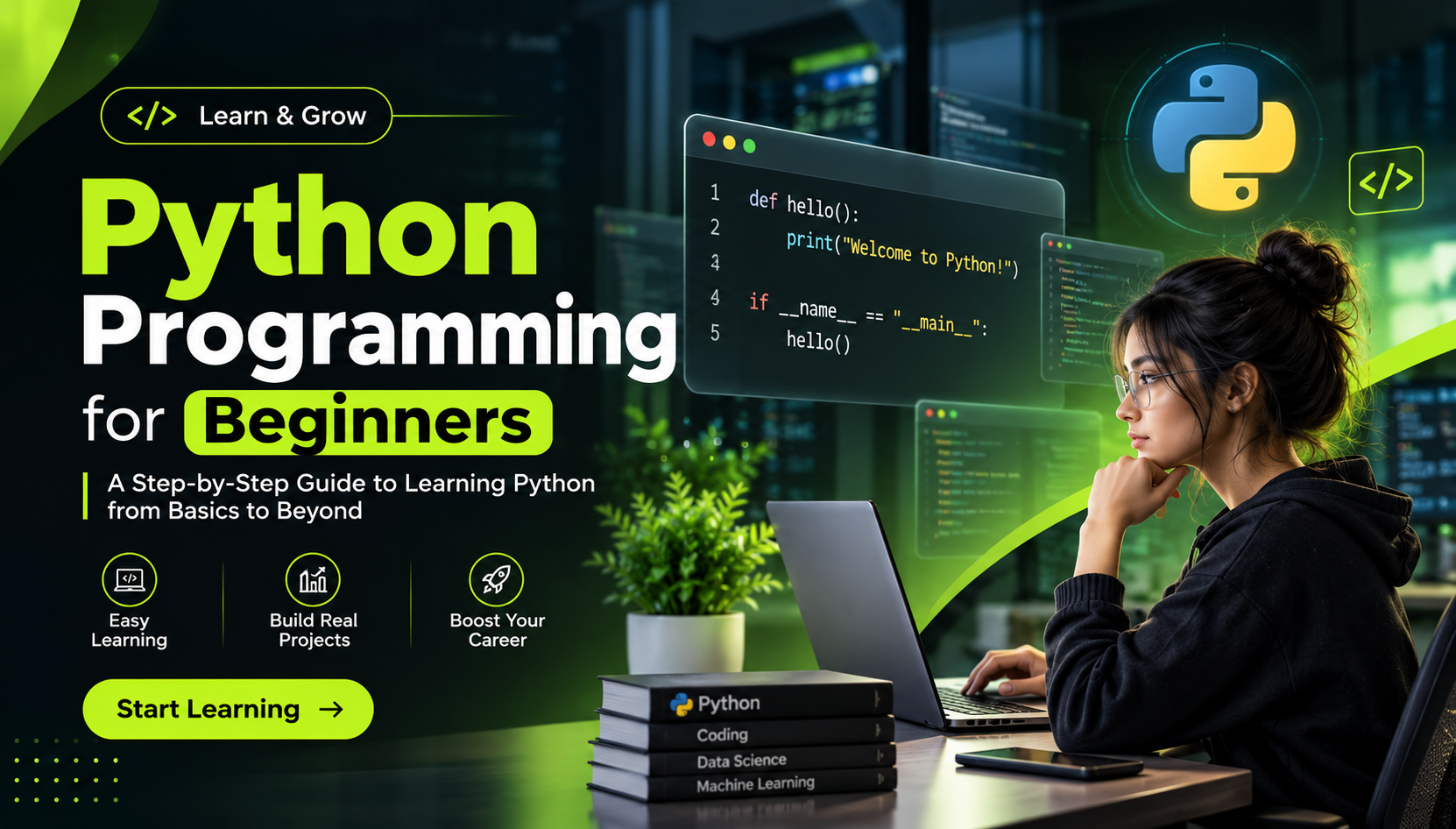
In order to pursue your interests in technology, software development or data science, you will need to learn a programming language. With so many options available, it may seem overwhelming to choose which programming language to begin learning. Python is often recommended as a great first programming language due to its ease-of-use, readability, and flexibility.
Python is an ideal language to start with when developing an understanding of how coding works. You may wish to use Python to create web sites, automate daily tasks, analyze and process data, or investigate Artificial Intelligence; regardless of what your goal is, using Python will provide you with a solid base.
In this guide, you will gain an understanding of what Python is, why Python is so popular, how to get started using Python, and what the most important fundamentals of Python are that you need to master before you can begin to use Python effectively. Additionally, you will be able to see some examples of practical uses of Python, examples of beginners' coding with Python, and possible careers that are available to those who have mastered Python.
What Is Python Programming?
Python is a general-purpose programming language that has been designed for creating various types of software, web pages, applications, and automated scripts. It was developed by Guido van Rossum and made available to the public in 1991.
Python is well-known for being a language with very clear and easy-to-read syntax. As such, it can be understood much quicker than other programming languages. The majority of the time, Python code will look similar to everyday English. This allows beginner programmers to concentrate on developing their understanding of programming logic rather than the complexities associated with the syntax of the language.
For example, you can display a message using just one line of Python code:
print("Hello, World!")When you run this program, the output will be:
Hello, World!This simple example shows why Python is a popular choice for people starting their coding journey.
Why Should Beginners Learn Python?
Python is a great programming language for students, professionals, and recent graduates who are interested in learning technical skills. The flexibility that Python provides allows people to try out various forms of technology without having to switch over to a completely new programming language right away.
Here are some important reasons to learn Python:
Easy to Understand
Python is written with simplicity in mind. This makes it easy for beginners to learn the fundamentals of programming through simple examples.
Useful for Different Fields
Python can be utilized for web development, data science, artificial intelligence, machine learning, automation, and software development.
Large Learning Community
Python has a worldwide developer base. There are many resources available for beginners including tutorials, documentation, code snippets and solutions to many common programming challenges.
Supports Practical Projects
Python allows you to create calculators, small games, automated scripts, data analysis software, and numerous other applications.
Free and Open Source
Python is open-source and free for all users. Therefore, students can begin their study of programming with Python before they have to pay for an expensive license to a commercial programming language.
Features and Benefits of Python
Before beginning your coding, it is beneficial to have an understanding of the key characteristics which have made Python so well-received by other developers.
- Simple Syntax: Python uses simple to read code which will help beginners learn about computer science concepts.
- Interpreted Language: An interpreted language like Python uses an interpreter to run its program. This makes it easier for developers to create and test their programs.
- Cross-Platform Support: Python programs can run on Windows, macOS, and Linux.
- Large Standard Library: It has many built-in modules that allow you to work with files, dates, math problems, and other common tasks.
- Object-Oriented Programming: Python supports classes and objects to organize and manage your code.
- Extensive Libraries: Tools like NumPy, Pandas, Django, Flask, and TensorFlow help with different kinds of development tasks.
These features make Python useful for both beginners and experienced developers.
Basic Python Concepts Every Beginner Should Learn
It is critical to understand the fundamentals of programming prior to exploring more complex aspects. Below are five foundational concepts you should begin with.
1. Variables
Variables are used to keep track of information in a program. You can use variables to hold numbers, strings (text), lists, etc.
Example:
name = "Rahul"
age = 20
print(name)
print(age)
Output:
Rahul
20
In this example, name stores a person's name, while age stores a number.
2. Data Types
Python has various built-in data types that provide a way for developers to specify what type of data is being assigned to a particular variable.
Common Python data types include:
- Integer (int): Stores whole numbers, such as 10, 25, and 100.
- Float: Stores decimal numbers, such as 10.5 and 25.75.
- String (str): Stores text, such as "Hello Python".
- Boolean (bool): Stores either True or False.
- List: Stores multiple values in an ordered collection.
- Dictionary (dict): Stores information in key-value pairs.
Example:
name = "Amit"
age = 21
marks = 85.5
is_student = True
print(type(name))
print(type(age))
print(type(marks))
Data types in Python help to determine what type of data Python will handle.
3. Operators
An operator is a symbol used to carry out various types of tasks with both values and variables. Some common types include:
- Arithmetic Operators: Addition, subtraction, multiplication, and division.
- Comparison Operators: Equal to (==), greater than (>), and less than (<).
- Logical Operators: AND, OR, and NOT.
- Assignment Operators: Used to assign or update variable values.
Example:
a = 10
b = 5
print(a + b)
print(a - b)
print(a * b)
Output:
15
5
50
4. Loops
Loops allow you to run a group of statements over and over again. This is great for performing the same operation many times.
Python mainly provides two types of loops:
For Loop: Used to iterate over a sequence or range of values.
for i in range(1, 6):
    print(i)
While Loop: Repeats a block of code as long as a condition remains true.
count = 1
while count <= 5:
    print(count)
    count += 1
Both examples display numbers from 1 to 5.
5. Functions
Functions can be used over and over again to do a certain thing. Using functions will make your program organized and help you avoid repeating yourself.
Example:
def greet():
    print("Welcome to Python Programming")

greet()
Output:
Welcome to Python ProgrammingYou can also create functions that accept values and return results.
def add(a, b):
    return a + b

print(add(10, 20))
Output:
30Functions are important for writing organised and maintainable programs.
How to Write Your First Python Program
After understanding the basic concepts, it is time to create a small program.
Let's create a basic Python program which prompts for a user to input their name, then outputs a friendly greeting.
name = input("Enter your name: ")
print("Welcome to Python,", name)
Example Output:
Enter your name: Rahul
Welcome to Python, Rahul
This program introduces you to two important Python functions:
input()takes information from the user.print()displays information on the screen.
Change the message or create a program which asks the user for their age. Exercises such as this will allow you to learn how to solve problems.
Practical Applications of Python Programming
Python is used in several real-world industries as well as technical fields beyond simple coding projects.
1. Web Development
Python's web development frameworks like Django and Flask allow developers to build web sites, web applications, and back end systems.
2. Data Science and Data Analysis
Python libraries such as Pandas, NumPy, and Matplotlib help developers analyse information, process datasets, and create visual reports.
3. Artificial Intelligence and Machine Learning
Python is heavily utilized in the development of machine learning models, intelligent applications, and artificial intelligence (AI) based systems.
4. Automation
Automate repetitive tasks (such as managing files, processing data, and generating reports) using Python.
5. Software Development
Python is used by developers for building applications, developing software tools and developing back-end systems.
The use cases presented demonstrate how learning Python will enable you to investigate various technological fields.
Frequently Asked Questions (FAQs)
1. Is Python easy to learn for beginners?
Yes. Python's easy-to-understand syntax and easily-readable code makes it a good option for those without prior programming experience.
2. Can I learn Python without knowing coding?
Yes. It's okay for you to begin learning Python even if you have no prior experience coding. First, learn the basics of the language, then advance to hands-on programming.
3. How long does it take to learn Python?
The time it takes to learn the material will depend upon how fast you are able to grasp the material, as well as the amount of time you spend practicing. You should expect that you will be able to learn the basic concepts in a matter of weeks; however, developing the ability to apply those concepts in a practical setting, and then working on projects using those concepts, can require months.
4. What should I learn after Python basics?
Once you have mastered the basics of Python, there are many areas of programming that can be explored including object-oriented programming, how to work with files, working with databases, accessing and using APIs, and using other Python libraries. Select from the more advanced topics based on what area of programming interests you as part of your career development.
5. Can Python help me build a career in IT?
Yes. Python is applied within many different IT areas such as software development, web development, data science, automation, and machine learning. In addition to Python being a valuable language for use in these types of applications, having practical knowledge/experience and specialized abilities will help you find a job using Python.
Conclusion
Python is an excellent language to start learning to develop software and use technology. The language's easy to read syntax, real-world uses, and vast library of tools are all great reasons why people choose Python as their first programming language.
The first step to learning how to code is getting comfortable with basic programming concepts such as variables, data types, operators, loops, and functions. After that you can start practicing writing small programs, learn about various types of applications, and eventually begin developing real-world projects. It is okay if you make errors while coding since error-checking (or debugging) and finding solutions to problems are both critical aspects of learning programming.
If you want to develop your coding skills with structured guidance, explore the Python training opportunities at Training Jaipur. With consistent practice and the right learning approach, you can build a strong programming foundation and move towards your technical career goals.